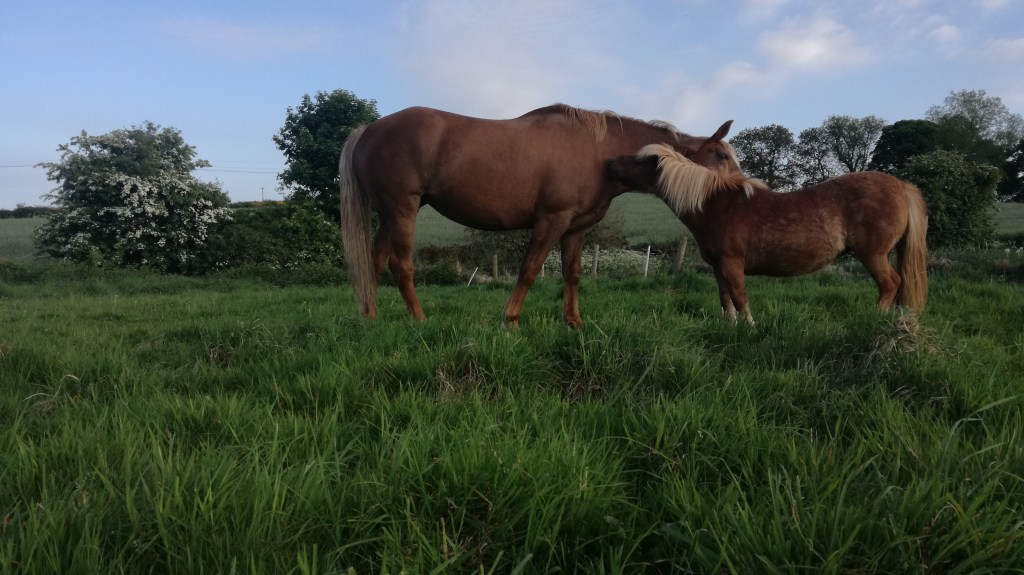
I am delighted to see the latest paper on grief in horses from Ricci-Bonot, Wilson, Uccheddu and Mills, just published in Applied Animal Behaviour Science. There have been so few scientific studies examining this, however, speak to a wide range of horse owners and many will describe what sounds like grieving behaviours when their horses have lost close companions.
I have experienced this many times over the years, both on a personal level with my own herd and on a professional level with clients horses. I have always felt that horses have benefited the most (and grief like behaviour has been least marked) when the horses have had the opportunity to spend time with their lost companion’s body after the event. So I’m particularly pleased to see that this study suggests some evidence to back up that observation.
“Whether or not the surviving horse had spent time with the dead body did not affect its behaviour in the first 24 h of loss. However, within 6 months after the death of the companion, horses who could spend time with the body had no change in vocalisation (p = 0.005) and excitement to interact with others and/or to feed time (p = 0.022). Conversely, horses who could not spend time with the body were more likely to show a change in arousal (p = 0.038) and vigilance (p = 0.033).”
I am sure there are further significant factors, including (but not limited to) the type of weaning and subsequent attachment styles or separation issues that each horse experienced, as well as the size and stability of the herd at the time of death, the continuity of care, the quality of the other relationships (including with the care giver) and perhaps also the age of the remaining individual and previous history and experience of loss.
We are often told it is an error to anthropomorphise (ascribe human emotions to animals inappropriately), however, it is also an error to dismiss the presence of emotions in animals simply in the name of avoiding being anthropomorphic!! There is such a thing as valid anthropomorphism, and as studies like these continue to show, the emotional lives of horses (and all animals) are far more complex than has previously been accepted by many in both the scientific and equestrian communities.
How horses feel matters, and the steps that we take in management, handling and training are significant in terms of the impact they have on our horses’ well being. We have a duty of care and that duty means that we must be aware of and responsive to how they are feeling, whether that means adjusting our management or our training approach. We need to understand the needs of horses in general, but also look at each individual and how their life history and current handling impacts upon them if we want to be able to provide a Good Life for each horse in our care.
If you’d like to learn more about the psychology of horse training and management, why not take a look at some of my online courses at https://www.psy-htec.com/
Exciting new courses for professionals/ aspiring professionals coming soon, to stay up to date sign up to my mailing list at https://spencehorsesense.com/sign-up-for-my-mailing-list/
To access the article quoted above just click on this link https://doi.org/10.1016/j.applanim.2025.106799
 Spence Horse Sense
Leave a comment